
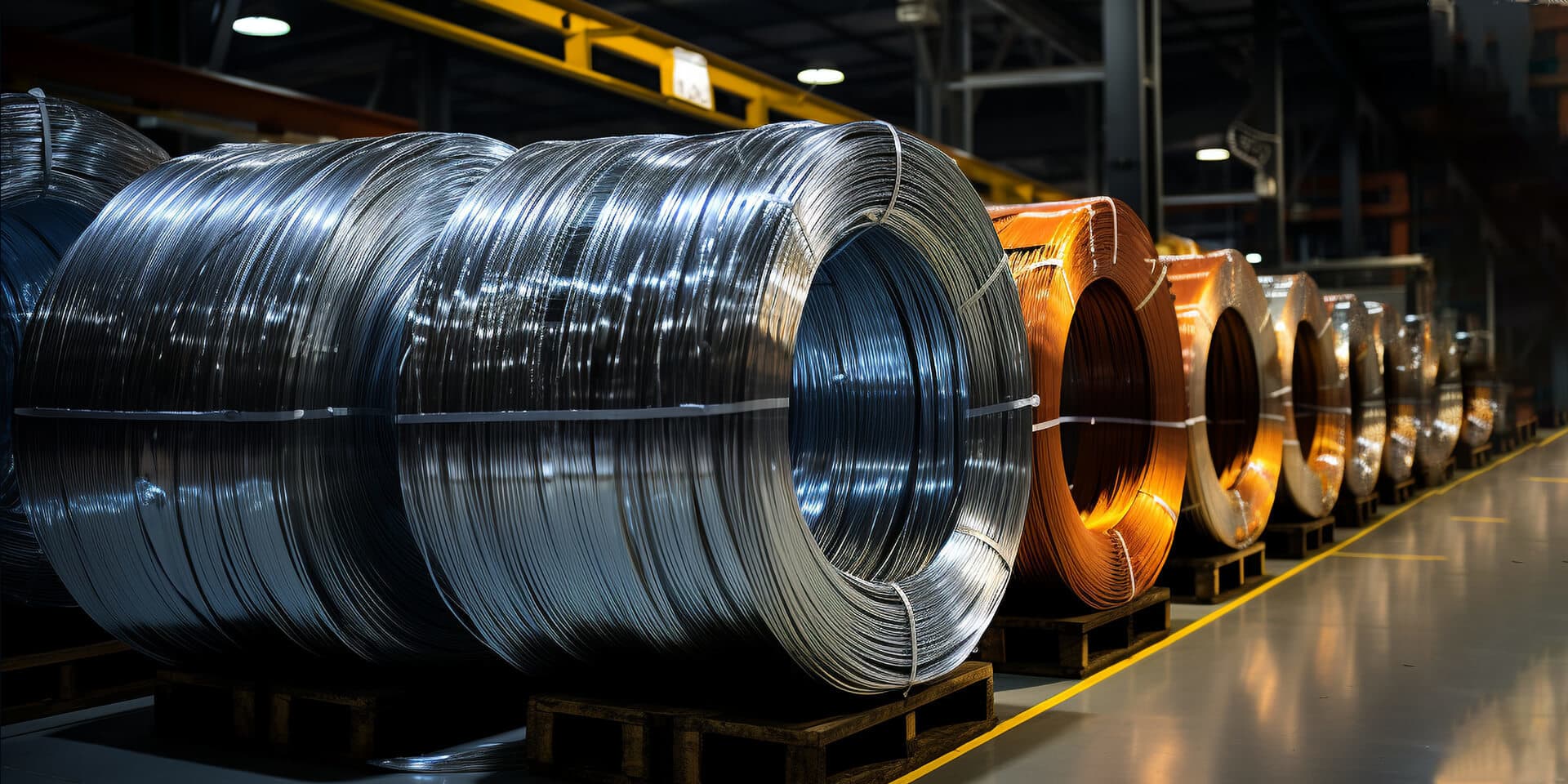

Short answer: Bring your cable application, governing standard and a one-page requirement sheet. Then ask each armour-material supplier the same seven questions about application fit, wire versus tape, dimensions, mechanical properties, zinc coating, test evidence and export packing. The goal is not to collect the most catalogues; it is to leave Shanghai with a shortlist that can answer your specification in measurable terms.
| Discussion area | Evidence to request | Record after the meeting |
|---|---|---|
| Application fit | Relevant product range, limits and required buyer inputs | Open technical questions and responsible contact |
| Dimensions | Production range, tolerance and sample measurement record | Confirmed requirement and proposed deviation |
| Mechanical properties | Test method, lot definition and redacted batch result | Approved range or clarification required |
| Zinc coating | Class or mass, adhesion method and example result | Project-specific coating decision |
| Documentation | Redacted MTC and traceability example | Missing fields and inspection scope |
| Packing | Photos, unit dimensions and export-packing description | Destination-specific changes, owner and deadline |
wire China 2026 is scheduled for 21–24 September at the Shanghai New International Expo Centre, according to the organiser. For cable buyers, the show creates a useful comparison window: multiple suppliers, processes and test approaches can be discussed in a few days.
That efficiency disappears when meetings begin with only “What is your best price?” Price is meaningful after the material, test scope, packing and order conditions are aligned. A short technical question set makes each conversation easier to compare.
Before the show: prepare a one-page buyer brief
Do not bring a confidential cable drawing unless your disclosure process allows it. A concise, non-sensitive brief is usually enough for a first qualification conversation. Include:
- cable type and end-use environment;
- approved armour form: round wire, steel tape or “under design review”;
- governing standard and project-specific additions;
- required dimensions and tolerances;
- mechanical-property and zinc-coating requirements;
- coil, spool or strip-coil format;
- estimated quantity, destination and target timing;
- required MTC, inspection or sample-approval process.
Mark every field as “confirmed,” “target” or “to be advised.” That prevents an early estimate from being mistaken for a final specification.
Question 1: Which cable applications does this product actually support?
Ask the supplier to connect the material to a cable construction and service environment. A useful answer explains why a particular wire diameter, strip size, tensile range or coating is appropriate for the stated design. A weak answer repeats a broad phrase such as “for all power cables.”
For submarine or offshore applications, ask about coating adhesion, surface criteria, batch consistency and seaworthy packing. For buried power cables, discuss ground moisture, processing behaviour and the project’s required armour structure. The supplier should stay within the material scope and avoid claiming that one component guarantees complete cable-system performance.
Question 2: Should this design use round wire or steel tape?
If the armour form is not yet frozen, ask the supplier what information is needed to evaluate manufacturability—but keep the cable designer in control of the decision. Round wire and steel tape form different armour structures. They differ in dimensions, processing, mechanical duty and inspection points.
A credible supplier will ask about the approved cable design, installation method and governing standard. Be cautious if the recommendation is based only on whichever product the supplier happens to sell.
Question 3: Which dimensions and tolerances can you hold in production?
For round wire, discuss nominal diameter, permitted deviation, ovality if relevant, coil or spool dimensions and unit-weight range. For tape, discuss thickness, width, tolerance, camber, flatness, edges and coil build.
Ask for the normal measurement frequency and whether actual results appear on the batch record. A sample measurement is useful, but the more important question is how the process stays within tolerance across the full order.
Question 4: How are mechanical properties specified and tested?
Do not accept “high tensile” or “soft quality” as a final requirement. Ask for the permitted tensile range, elongation requirement where applicable, test method, sample size and lot definition. Then connect those numbers to line behaviour: pay-off, forming, spring, kinks, tape tracking or the customer’s approved process window.
If a supplier proposes a substitute range, request a written deviation and technical review before pricing or sample approval.
Question 5: What does the zinc-coating requirement mean—and how is it verified?
“Galvanised” and “heavy zinc” are starting descriptions. The order needs a standard, coating class or minimum mass, test method, adhesion requirement and surface acceptance criteria.
Ask the supplier to show how coating-mass and adhesion results are reported. For demanding marine environments, discuss uniformity and handling damage as well as the nominal coating mass. A very high number on a brochure does not resolve poor adhesion or an undefined sampling plan.
Question 6: Which reports and traceability records come with the shipment?
Request a redacted sample MTC before placing the order. Check whether it contains the fields your quality team expects, such as dimensions, tensile strength, elongation, zinc-coating mass, adhesion result, standard and heat or batch number.
Then ask how the batch number appears on the coil or spool label and packing list. If the buyer requires SGS, BV or another customer-designated inspector, agree whether the work is sampling, witnessed testing, finished-goods inspection or container-loading supervision. The organisation’s name alone does not define the scope.
Question 7: How will the material be packed, labelled and prepared for export?
Technical conformity can be undermined by unsuitable packing. Confirm coil or spool dimensions, unit weight, wrapping layers, moisture protection, palletisation, lifting points, label language and container securing. Share the destination and any unloading restriction.
For mixed orders of wire and tape, ask for a packing map and unambiguous labels. The receiving team should be able to identify the material without opening every package.
A supplier-comparison sheet for the show
- Application fit: request the relevant product range and its limits. Record the technical owner and any unanswered design inputs.
- Dimensions: request the production range, tolerance and a sample measurement record. Record the required sample size and format.
- Mechanical properties: request the test method, lot definition and a redacted batch result. Record any proposed deviation from the buyer’s range.
- Zinc coating: request the coating class or mass, adhesion method and an example result. Record the project-specific confirmation still required.
- Documentation: request a redacted MTC and traceability example. Record missing fields and the required inspection scope.
- Packing: request photos, unit dimensions and the export-packing description. Record destination-specific changes and cost.
Use A/B/C follow-up tiers after each conversation
The Foreign Trade 101 “King” client case offers a practical lesson: a trade-show contact list becomes useful only after it is prioritised. The case used A/B/C tiers to separate immediate opportunities from promising follow-ups and longer-term contacts. For public content, the method can be shared without exposing customer names, personal details or private commercial data.
- A — specification-ready: clear project, relevant material, next action and timing. Send the requested technical file or quotation path promptly.
- B — qualified but incomplete: real application, but one or more decision inputs are missing. Follow up with a focused question list.
- C — early-stage: general interest or future potential without a current requirement. Add value through a buyer guide, standard explanation or periodic update.
The tier should reflect evidence from the conversation, not the size of the visitor’s company or the enthusiasm of a business-card exchange. Record the next action, owner and date before moving to the next meeting.
How Zhongbo would answer the seven questions
Zhongbo manufactures hot-dip galvanised round steel wire and galvanised steel strip for cable armouring. Public product information covers round wire from 0.8 to 8.0 mm, with 1.5 to 6.0 mm commonly used for armour, plus galvanised strip manufactured to the customer’s dimensional and coating requirements.
The company can discuss batch records covering dimensions, tensile strength, elongation, zinc-coating mass, adhesion and traceability, together with customer-designated inspection and seaworthy export packing. Exact ranges, standards and documents must be confirmed against the inquiry. This article does not state that Zhongbo has a wire China booth; meeting details will be published only after participation and location are confirmed.
Frequently asked questions
When and where is wire China 2026?
The organiser lists 21–24 September 2026 at the Shanghai New International Expo Centre. Check the official website before travel in case visitor arrangements change.
Should buyers ask for a quotation at the show?
Yes, if enough technical and commercial inputs are available. Otherwise, agree the missing information and a follow-up deadline instead of requesting a price built on assumptions.
What should be left out of a first meeting brief?
Exclude customer-confidential drawings, personal data and sensitive commercial terms unless an approved disclosure process and NDA are in place.
How quickly should suppliers follow up?
Time depends on the request. A short acknowledgement and missing-information list can be sent quickly; a technical quotation should wait until critical specifications are confirmed.
Call to action: Preparing a cable-armour sourcing brief for Shanghai? Send Zhongbo your non-confidential specification in advance. The team can identify the technical fields needed for a meaningful wire or steel-tape discussion.
Related resources
- Steel wire vs steel strip for cable armouring — the longer-form comparison behind Question 2, covering armour structure, processing and inspection differences.
- Test reports and third-party inspection — the batch documentation and inspection process referenced in Question 6, including MTC fields and customer-designated inspection.
- Packing and shipping — the coil, spool and export-packing formats referenced in Question 7, with labelling and container-loading practice.
Sources and context
- wire China 2026 official website — the organiser’s published dates, venue and visitor information for the Shanghai fair.
- Zhongbo Steel — power cable armouring, the published wire diameter range, strip sizes and governing standards referenced in this article.
- Zhongbo Steel — test reports and third-party inspection, the batch documentation and inspection scope referenced in this article.


